Greta Günther · 22 September 2026
Scientists Uncover Hidden Symbiotic Relationships Thriving in the Humid Understories of Fog-Shrouded Habitats
Researchers have documented intricate symbiotic networks operating within the understory layers of fog-shrouded forests where consistent moisture supports multi-species interactions that sustain nutrient cycling and species resilience across these ecosystems. In September 2026 a collaborative study from field stations in Central American cloud forests and European temperate rainforests revealed previously unrecorded partnerships between mycorrhizal fungi, epiphytic bryophytes, and ground-dwelling arthropods that exchange carbohydrates, water, and defensive compounds through shared root and hyphal pathways.
Discovery Context and Field Methods
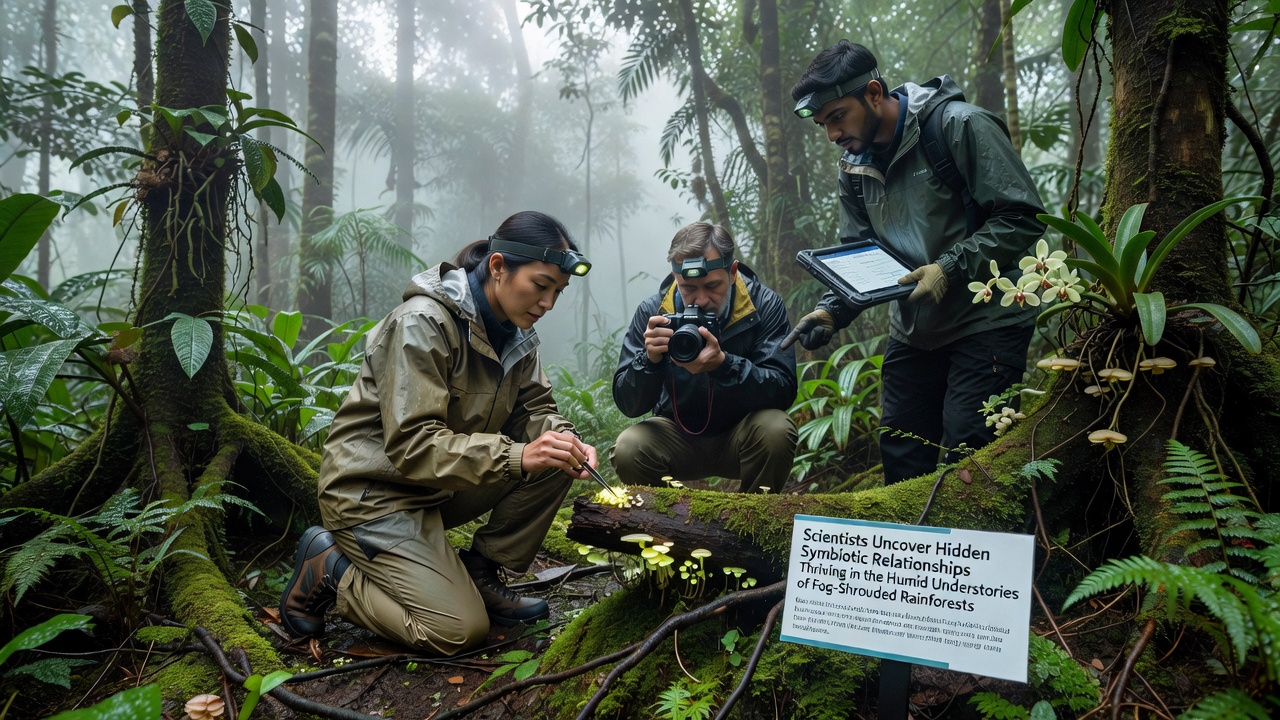
Teams deployed sensor arrays and micro-sampling techniques to map activity beneath dense canopy cover where light penetration remains minimal yet humidity levels stay near saturation throughout the year. Data collected over eighteen months showed that certain orchid species form triple associations involving fungi and nitrogen-fixing bacteria, allowing the plants to thrive in nutrient-poor leaf litter while the microbes receive fixed carbon in return. Observers noted that these exchanges intensify during peak fog events when water films facilitate molecular transport between organisms separated by only millimeters of soil and decaying wood.
Key Symbiotic Interactions Identified
One documented relationship centers on liverworts that harbor cyanobacteria capable of nitrogen fixation while the liverworts supply shelter and photosynthates, and this partnership extends further when springtails graze on the liverwort surfaces and inadvertently spread cyanobacterial cells to new patches. Another interaction involves tree seedlings that receive phosphorus from fungal networks connected to older canopy trees, and in exchange the fungi obtain lipids synthesized by the seedlings during brief periods of filtered sunlight. Researchers mapped these connections using stable isotope labeling, confirming that carbon atoms move from canopy leaves down through trunks and into understory roots within forty-eight hours under high-moisture conditions.
Additional findings highlight how certain ground beetles maintain gardens of slime molds that break down organic debris faster than free-living microbes alone, and the beetles receive concentrated nutrients when they consume portions of the molds. Studies indicate these gardens expand most rapidly when fog drip maintains soil moisture above eighty-five percent, allowing continuous decomposition even during cooler months. Data from similar habitats in the Pacific Northwest show comparable patterns where different beetle species perform parallel roles, suggesting the strategy has evolved independently across regions.
Broader Ecosystem Implications
Evidence from long-term monitoring plots demonstrates that removal of any single partner in these networks leads to measurable declines in seedling survival rates and slower litter breakdown, which in turn affects carbon storage in the upper soil horizons. According to reports from Australia's Department of Climate Change, Energy, the Environment and Water, comparable understory communities in Tasmanian temperate rainforests exhibit parallel dependencies that buffer against seasonal dry spells. The Canadian Forest Service has likewise recorded shifts in mycorrhizal community composition following canopy gaps, underscoring how fog regimes influence belowground connectivity across hemispheres.
Genetic analyses further reveal that some fungal strains possess unique gene clusters for producing antimicrobial compounds that protect associated plants from root pathogens, and these compounds appear only when the fungi detect chemical signals from the host roots. Such conditional expression keeps metabolic costs low while providing targeted defense during periods of high microbial activity triggered by constant moisture.
Conclusion
Continued monitoring through 2027 will track whether these understory symbioses remain stable under changing precipitation patterns, and researchers plan to expand isotope tracing to quantify the full extent of resource sharing across entire forest stands. The accumulated evidence shows that fog-shrouded habitats function as tightly integrated systems where hidden partnerships determine overall productivity and species persistence, with each new layer of interaction adding detail to the functioning of these persistently humid environments.